
What Is Power Flushing?
Power flushing is a deep clean of a wet central heating system. A flushing pump is connected into the circuit, usually in place of the boiler's pump or a radiator, and pushes water and cleaning chemicals through the pipes and radiators at high flow, reversing direction to dislodge magnetite sludge, limescale and corrosion debris. The dirty water is dumped and replaced with clean water until it runs clear, then the system is refilled with corrosion inhibitor.
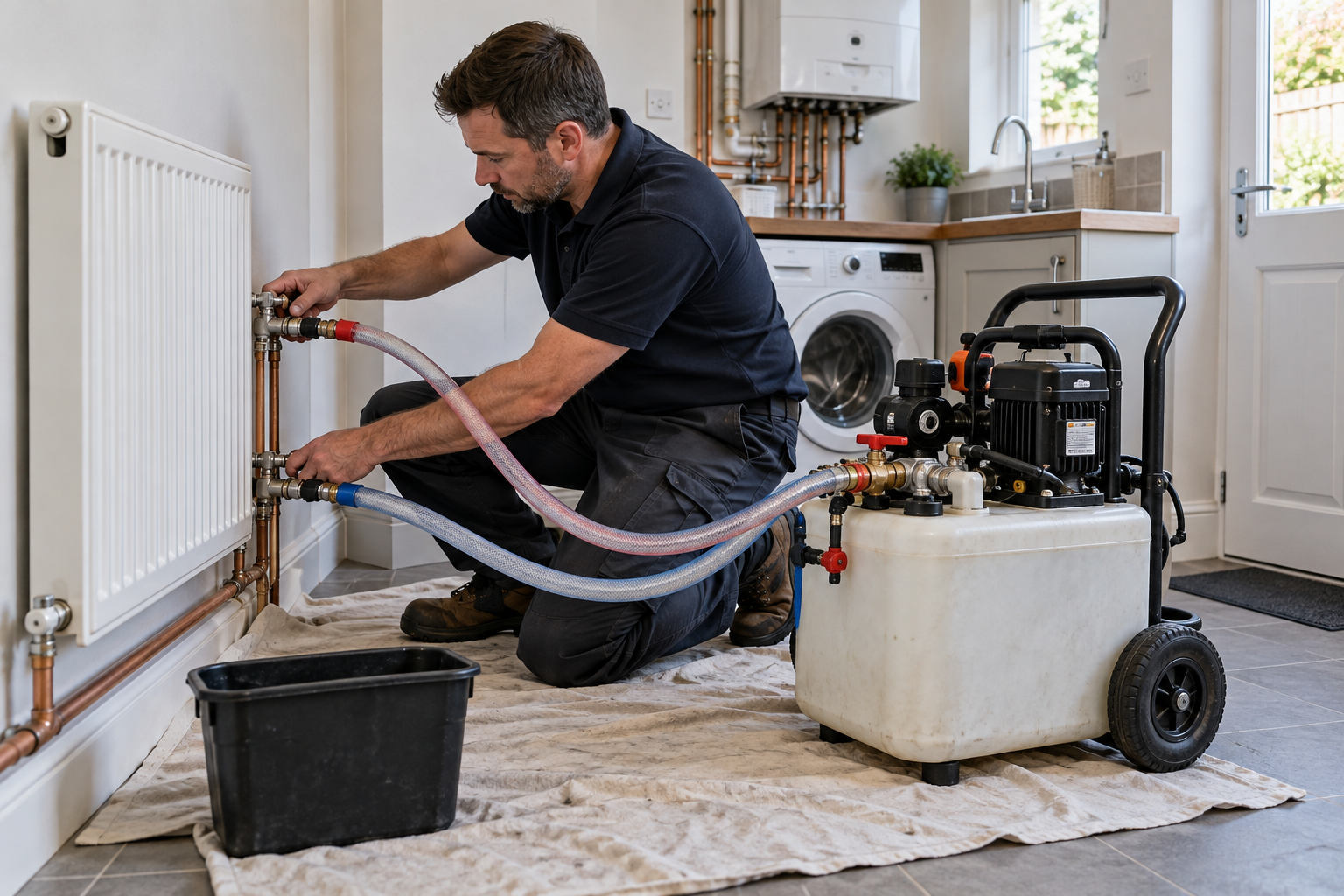
Over the years, the steel inside radiators slowly corrodes and forms a black iron-oxide sludge that settles at the bottom of radiators and clogs narrow passages in the boiler's heat exchanger. Power flushing is used to clear that build-up on an existing system, and is often recommended before a new boiler is fitted so the old system's debris doesn't damage it.
Signs Your Heating System Needs a Power Flush
- Radiators are warm at the top but stay cold along the bottom
- Water released when bleeding a radiator is black, brown or sludgy
- The boiler is kettling — a rumbling or whistling sound as water boils in a blocked heat exchanger
- Radiators furthest from the boiler take much longer to warm up than the rest
- Radiators need bleeding repeatedly, a sign of gas from ongoing corrosion
- An engineer has found blocked boiler parts or a sludged-up pump or diverter valve
System Cleaning Methods Explained
- Power flush — a dedicated machine circulates chemicals at high flow, with each radiator isolated and flushed in turn, often with a hand-held vibrator used on the panels to loosen settled sludge. The most thorough option for heavily contaminated systems.
- Chemical clean via the system's own pump — a cleaner is added and circulated for a period with the heating running, then drained and refilled. Gentler and cheaper, suited to lightly contaminated or newer systems.
- Mains-pressure or gravity flush — clean water is run through each radiator and drained away. Often used on new systems to remove installation debris and flux.
The water treatment guidance in BS 7593 recommends that a system is cleaned and treated with inhibitor when a new boiler is installed, and boiler manufacturers often make this a condition of their warranty. Very old systems with weak pipe joints or thin radiators may not tolerate the pressures of a full power flush, so a chemical clean is sometimes the safer choice.
What to Include When Asking for a Quote
Tell the engineer how many radiators and towel rails you have, whether the system is sealed (with a pressure gauge on the boiler) or open-vented (with a small feed-and-expansion tank in the loft), and the boiler's make and age. Describe the symptoms — which radiators have cold spots, what colour the water is when bled, and any noises — since that tells them how heavily contaminated the system is likely to be.
Ask what the price includes. A full quote should state the cleaning method, the chemicals used, whether every radiator will be individually flushed, and whether inhibitor and a magnetic filter on the boiler return pipe are part of the job. Many engineers check water quality with a TDS meter or test strips before and after, and some offer a written cleanliness record, which is worth having for a boiler warranty.
Mention any radiators with stiff valves, visible corrosion or past leaks. A flush can expose weak points that were being sealed by sludge, and a good engineer will tell you in advance how they handle leaks that appear during the clean.
How Much Does Power Flushing Cost?
| System size | Typical cost |
|---|---|
| Flat or small house (up to 6 radiators) | £300 – £400 |
| Typical 3-bed house (8–10 radiators) | £400 – £550 |
| Larger home (12+ radiators) with magnetic filter fitted | £550 – £700 |
Adding a magnetic filter usually costs extra if one isn't already fitted. Replacing valves or radiators found to be failing during the flush is priced separately.
The Power Flushing Process: What to Expect
- Inspection and testing. The engineer checks radiators, valves and system water, and may take a water sample.
- Connecting the pump. The power flushing machine is connected, usually at the circulating pump or a radiator.
- Chemical circulation. Cleaning chemicals are added and circulated through the whole system, with flow direction reversed regularly.
- Radiator-by-radiator flushing. Each radiator is isolated and flushed until the water runs clear.
- Neutralising and rinsing. Chemicals are dumped and the system is rinsed with clean water.
- Inhibitor and filter. The system is refilled, inhibitor added, the filter fitted or cleaned, and every radiator bled and checked.
Planning Permission and Building Regulations
Power flushing is maintenance work, so it doesn't need planning permission and isn't notifiable under the Building Regulations. Where a flush is carried out as part of a new boiler installation, it forms part of the commissioning that a Gas Safe engineer records on the Benchmark checklist. Waste water from flushing contains chemicals and sludge and should be disposed of to the foul drain, not to a surface water drain or the garden.
How to Choose a Power Flushing Engineer
- Ask whether they will flush each radiator individually, not just circulate chemicals
- Check they test the water before and after cleaning
- Confirm inhibitor is included and whether a magnetic filter is too
- Ask how they handle any leaks that appear during the flush
- Check they are Gas Safe registered if the boiler pump or boiler itself will be worked on
Frequently Asked Questions
How often should a heating system be power flushed?
There is no fixed interval. A system with good inhibitor levels and a magnetic filter that is cleaned at each annual service may never need another one. Flushing is needed when symptoms such as cold spots and dirty water appear, or before a new boiler is fitted to an older system.
Can a power flush damage my radiators?
A power flush doesn't create damage, but it can reveal it. Radiators or joints that were already corroded through and held together by sludge may start to leak once cleaned, which is why some very old systems are better suited to a gentler chemical clean.
Is a power flush needed when fitting a new boiler?
The system should be cleaned in line with BS 7593 when a new boiler is fitted, and most manufacturers require it for the warranty. On a heavily sludged system that usually means a power flush; on a cleaner one, a chemical clean may be enough.
How much does a power flush cost?
Most power flushes cost between £300 and £700, depending on how many radiators the system has and whether a magnetic filter is fitted at the same time.